Homadu or a custom-built website: which suits your holiday rental?
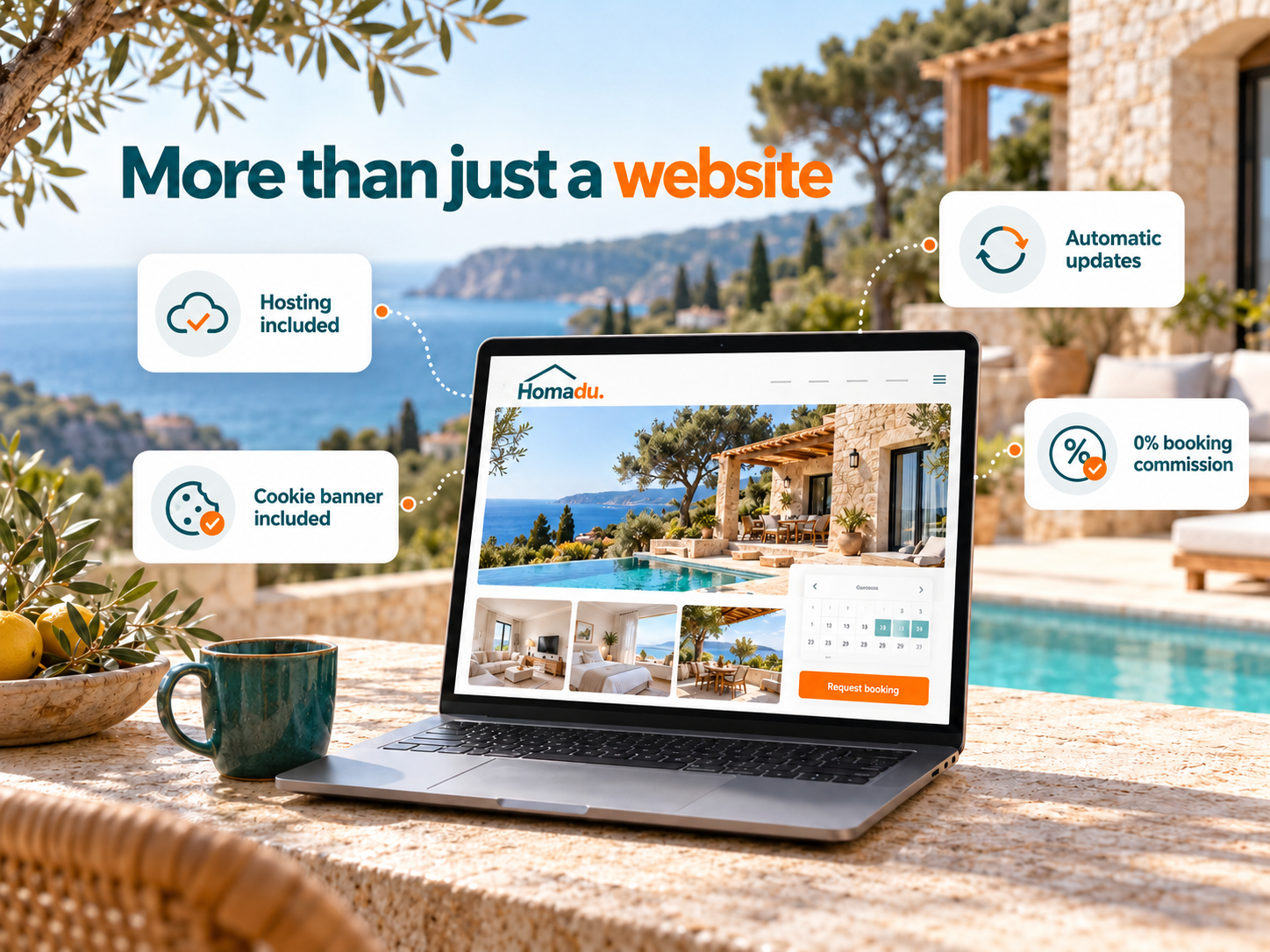
Homadu gives your holiday home its own website where guests can request a stay directly. There is no Homadu platform commission on those direct bookings, and hosting and the technical foundation are managed centrally. Does this connected rental environment fit your plans, or would a custom-built website suit you better? Compare what you get and how you want to work each day.
Start with the tasks your website needs to support
A digital business card mainly needs photos, a description and contact details. Once guests need to select dates and request a stay, availability, pricing, conditions and follow-up become part of the job. First list the tasks you handle and the information guests need. A web developer can deliver these parts as an integrated solution too; include them explicitly in your brief.
Do you want to present the property, or connect that presentation to rental management too? That distinction makes quotes easier to compare. For the broader decision, read what an independent holiday rental booking website involves.
What Homadu brings together
Homadu combines your rental website with rooms and beds, photos, facilities, house rules, location, reviews, languages, rates, a calendar and booking requests. You present the property and manage the related rental information in the same environment. You can use a subdomain or connect your own domain.
The value lies in bringing the work together: you present your property and manage the related rental information in one place. You update photos, rates and conditions yourself; Homadu provides the technical foundation. That lets you focus on your property and contact with guests.
Compare the full cost of the same scope
A quote for an attractive website may cover a different package from a rental-management subscription. For a custom build, ask what is included: design and development, mobile presentation, languages, entering content, a booking form, calendar, price calculation, hosting and maintenance. Establish what later changes cost and who resolves problems with integrations.
With Homadu, you pay a subscription; hosting and central technical maintenance are part of the service. Homadu charges no platform commission on direct bookings. You still need to allow for the subscription and any other costs, such as external services or payment arrangements. Compare domain registration and renewal separately. See Homadu’s pricing for the current offering. Compare both initial and recurring costs over the same period of use.
Who handles hosting, updates and the cookie banner?
With a custom website, you can arrange hosting and maintenance yourself or have your web developer handle them. Either can work well. Agree who performs updates, what maintenance covers and whom to contact if a change causes a problem. A managed maintenance package can take this work off your hands with a custom site too.
Homadu handles hosting and technical updates centrally. You do not need to maintain your own server or separate website plugins for this site. After the trial, a live website on an active paid subscription also includes a cookie banner.
When might a custom website fit better?
Consider a custom build if you have very specific design requirements or an unusual visitor journey. You might need a distinctive visual identity or a function outside the usual presentation and booking-request process for a holiday home. Discuss how the developer will deliver it and who will maintain the result.
Homadu suits owners who want to use its existing rental features and work within one connected environment. You set it up with your property details, photos and text. Check in advance whether its presentation options and settings fit your needs. The degree of design freedom is a meaningful decision to make before committing.
Compare the request process and calendar too
For either route, check exactly what guests submit and what you do afterwards. A direct booking through Homadu starts as a booking request. You accept or decline it, with the corresponding confirmation emails supporting the process. Explain your actual payment and cancellation arrangements clearly.
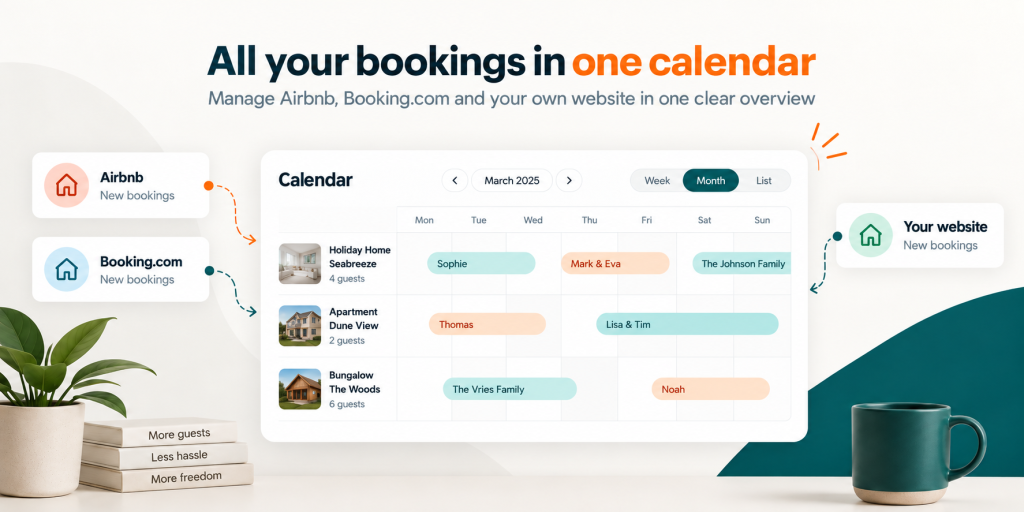
If you also use external platforms, include availability exchange in your comparison. Homadu can exchange occupied periods and blocks through iCal. Allow for possible calendar-update delays in your workflow. See connecting Airbnb and Booking.com calendars for the practical explanation.
Try setting up your own property during the trial
Use the trial to set up your own property: add photos and rooms, enter prices and conditions, and view the request process on a phone. Check the total for a specific stay and how your house rules appear. You can then assess Homadu against the work you actually want to do. For the next step in your rental business, read getting more direct bookings for your holiday rental.
Explore Homadu’s features and current pricing, then create an account to get started.