How to price your holiday rental: turn costs into workable rates
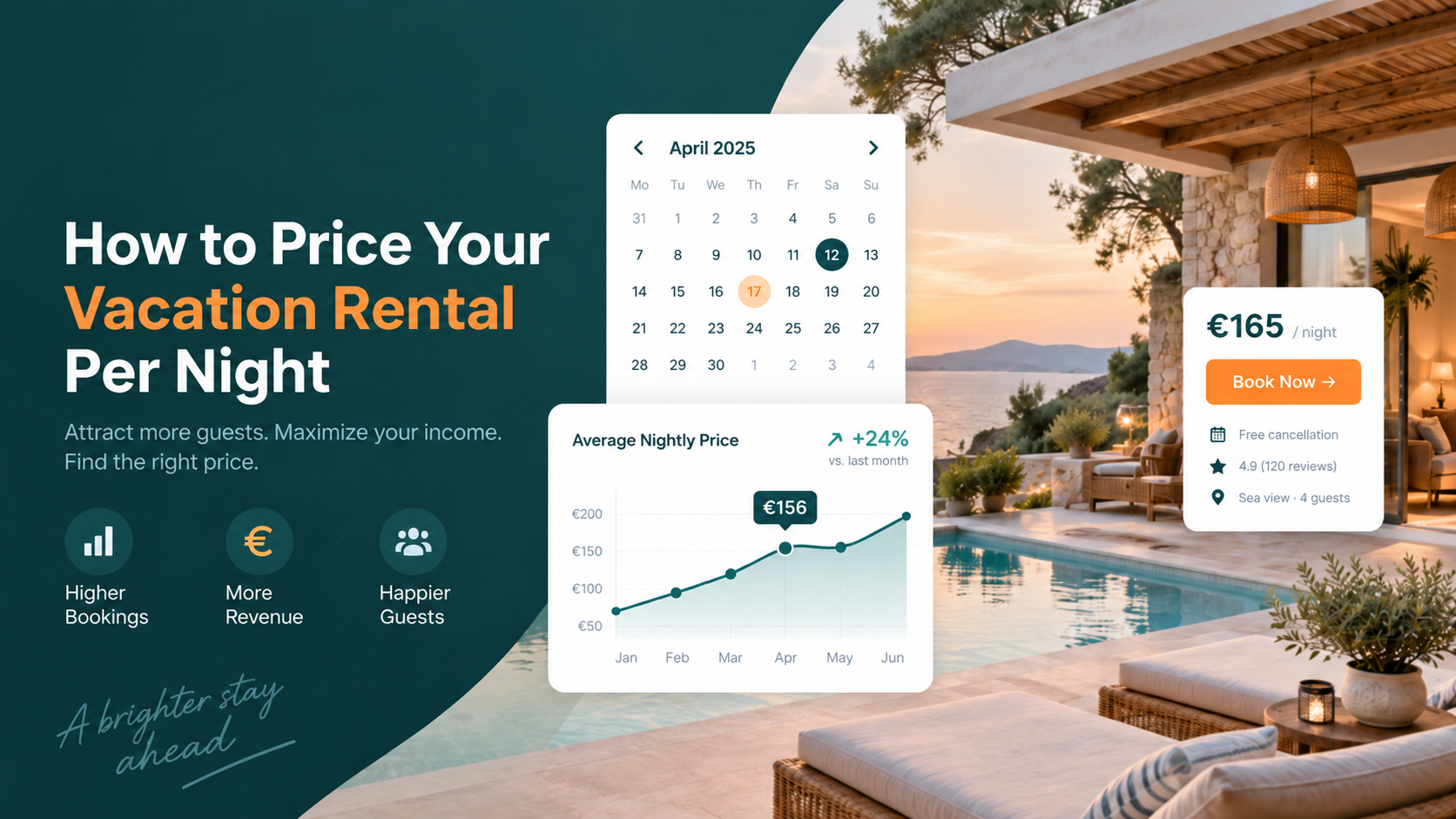
A workable nightly rate reflects your property, demand and the costs of hosting a stay. Following your neighbour or aiming for a full calendar is not enough: higher revenue does not necessarily leave you with more. Start with a cost budget, compare complete stays and build a manageable rate structure. Then review what those rates actually deliver.
Separate fixed costs, nightly costs and costs per stay
Fixed costs continue while the property is empty: insurance, standing subscriptions and a budget for maintenance and replacements, for example. Variable costs follow use, such as energy, water and consumables per occupied night. Cleaning, laundry and key handovers may arise per stay instead. Separate these items so one long stay is not treated like three short bookings. Make a deliberate allowance for your own working time.
Illustrative example: budget €12,000 in annual fixed costs, €20 per occupied night and €60 per changeover. You expect 180 occupied nights across 60 stays. Budgeted costs are €12,000 + (180 × €20) + (60 × €60) = €19,200. Covering these requires average rental income of €106.67 per occupied night. Divide by the nights you expect to sell, not by 365.
At an average rate of €140, rental income is 180 × €140 = €25,200. That leaves €6,000 above these budgeted costs. Cleaning is included in the rent in this example; do not count the same cleaning income again. Platform fees, payment processing, financing, your own labour and taxes are excluded. This is therefore neither net profit nor an income guarantee. This is an illustrative calculation: complete it for your own circumstances.
Compare similar properties and complete stays
Compare properties with similar capacity, location, furnishings and quality. Consider bedrooms, bathrooms, outdoor space, parking, reviews and distinctive facilities too. A villa with a pool is not a useful benchmark for an apartment without outside space.
Use the same dates, stay length and group size in each search. Compare the total including compulsory charges, rather than the advertised nightly rate alone. Check several periods and record the date and conditions of your comparison. An advertised price does not show whether anyone actually books at that rate, so treat it as a reference rather than proof of demand.
Choose a base rate and a manageable set of pricing periods
Your cost calculation gives you a starting point, but it does not mean the market will pay that amount. Choose a base rate you can explain and test. Add periods only where expected demand differs meaningfully, such as quieter months, school holidays or a local event. Consider your own audience: a summer destination and a city property for business travellers have different patterns.
Record which nights belong to each period. In Homadu, a pricing period’s end date includes the night beginning on that date. A period ending on 30 June therefore includes the night of 30 June to 1 July. The departure date itself is not an overnight stay.
Assess weekend and package rates across the whole stay
A weekend may support a different rate from a weekday, depending on your guests and location. Define clearly which nights your weekend covers. For a package, compare total income with the costs and work you save.
At €150 per night, seven nights cost €1,050. A weekly rate of €950 gives a €100 discount and average rental income of €135.71 per night. That may work if it reduces changeovers or awkward gaps, but check whether those benefits justify the discount. Longer stays still use energy and cause wear.
Homadu calculates packages within each pricing segment. Days from another segment are not added to complete a package. Check a weekend or week that crosses a pricing boundary as well.
Turn extra-person charges and extras into a clear guest total
More guests can mean higher costs. You can include a set number of guests in the base rate and charge per additional person per night, while respecting the property’s maximum capacity. Base the amount on your actual costs and market position.
A separate illustration: €160 per night for four people plus €15 per additional person gives a nightly rate of €190 for six guests. Three nights cost €570. Add €75 in compulsory final cleaning and the stay total is €645, assuming there are no other mandatory charges. Show a security deposit of, for example, €200 separately.
Distinguish included, compulsory and optional services. Describe linen, pets or breakfast only with the conditions you actually apply. Mandatory charges belong in the total; optional extras should be an informed choice. Guests should understand the price before sending a request.
Make stay rules support your pricing strategy
A minimum stay can prevent a single night from splitting an attractive bookable period. Use it selectively: a high minimum can also exclude suitable guests. Consider both expected income and the gaps left in the calendar. A stay requirement is a booking condition, not a calendar block.
In Homadu, minimum and maximum stay lengths depend on the check-in date. A period-specific maximum can replace the standard maximum, including with no limit. The period ending does not force the guest to check out. Someone arriving on its final day can continue their stay if availability and the other conditions allow it. Permitted checkout days are assessed using the rules on the checkout date. Test arrivals around period boundaries as well as stays in the middle of the season.
Compare what each booking channel leaves you
The same stay revenue can yield different returns through different channels. Deduct applicable platform fees, payment processing and other booking costs. Include fixed software and marketing costs too, allocating them consistently without counting them twice.
Homadu charges no platform commission on direct bookings. Your own website lets you present your rates and conditions yourself and stay in direct contact with guests. Include the subscription and any other costs in your budget so you can compare returns clearly. See also what an independent holiday rental booking website involves.
Review occupancy and results, then make focused changes
Measure occupancy against the nights you actually offer for rent. Track average rental income per sold night, stay length, changeovers, booking lead time and returns after the costs you have chosen to include. Compare similar periods; one empty weekend tells you little.
In the first example, 150 nights at €140 across 50 stays generate €21,000. The same €12,000 in fixed costs, €3,000 in nightly costs and €3,000 in changeovers leave €3,000 before the other items previously excluded. Fewer nights reduce variable costs, but fixed costs remain.
If future dates fill well in advance, you can test a higher price for dates still available. When requests are scarce, also check visibility, photos, the total price and conditions. Change one thing at a time and record the adjustment. Low occupancy does not automatically call for a discount.
Check your settings with trial stays
Homadu combines a standard rate with period rates and each pricing segment’s own nightly, weekend and package prices. Leaving a special price field empty in a period rate does not bring in the standard weekend or package price. Periods retain their own pricing; check what your settings produce for an actual stay.
Test an ordinary midweek stay, a weekend, a longer stay, additional guests and a stay across two pricing periods. Review rent, services, deposit and arrival and departure rules together. The cost overview has an expandable price breakdown; displaying a general guest rate overview is optional. For presentation advice, read how your property page can build trust.
Through your own Homadu website, guests can request a stay at the rates you have set. You review the request and accept or decline it. This connects your pricing to your own rental website. Schedule regular reviews and update the budget when costs, the property or demand change.

